
The Problem with Traditional Packaging
Walk into almost any warehouse, factory floor, or export yard, and you’ll still find the same three materials doing the heavy lifting: wooden crates, metal boxes, and paper cartons. They’ve been the default for decades, but anyone who’s actually worked with them knows the frustrations firsthand.
Wooden boxes are bulky and heavy, which drives up freight costs before the product inside even ships. They splinter, absorb moisture, attract pests, and need constant maintenance or fumigation for export compliance. Metal boxes solve the durability problem but bring their own baggage — they’re expensive, prone to rust, difficult to handle manually, and add significant dead weight to every shipment. Paper cartons are light and cheap, but they’re the least durable of the three — a bit of moisture or rough handling and the whole thing gives out, especially over multiple trips.
And there is a bigger issue sitting underneath all of this, none of these traditional options are particularly sustainable to environment. Wood means deforestation pressure. Metal is energy-intensive to produce and recycle. Paper cartons are typically single-use, and once damaged, they are waste not a reusable asset.
This is exactly the gap that heavy duty FLC box pallets are engineered packaging were designed to close and it’s the problem the AeroPro Box was built to solve.
The Solution: One Product, Two Manufacturing Approaches
Rather than offering a single one-size-fits-all box, the AeroPro Box comes in two engineered variants thermoformed and injection-molded. so businesses can match their requirement for FLC box with lid and pallet material to the actual job, instead of over-engineering or under-building for their needs.
It is not just a material swap. It’s a rethink of packaging as a system, where the pallet is chosen based on load, trip count, and application the same way you choose a vehicle based on cargo, not just because it has wheels. As one of the growing number of Flc box lid and pallet manufacturers in India moving away from single-use materials, we built have built AeroPro Box.
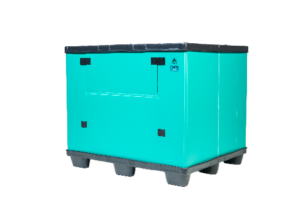
AeroPro Box — Thermoformed Variant (FLC Box lid and pallet for Storage)
Built for operations that need a lighter, cost-effective alternative to paper cartons and wooden crates without sacrificing structural integrity. This variant is a strong fit for businesses searching for reliable FLC box lid and pallets for storage rather than heavy racking use.
• It Handles 350 kg under G+2 stacking, and 500 kg under G+1 stacking
• Significantly lighter than wood or metal, which brings down manual handling effort and freight costs
• Excellent nesting capability, so empty pallets take up far less storage and return-transport space
• Good fit for one-way export shipments, light-load storage, and FMCG or pharma secondary packaging
• Rated for roughly 40–50 reuse trips — already a major upgrade over single-use carton boxes
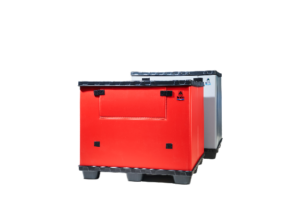
AeroPro Box — Injection-Molded Variant (Heavy Duty Pallet for Industrial Use)
Built for the heavy-duty use cases where wooden crates and metal boxes are traditionally forced into service. This is where the AeroPro Box functions as a true heavy duty pallet, engineered for the toughest industrial environments.
• It Handles 500 kg under G+2 stacking, and up to 1,000 kg under G+1 stacking
• It can carry high static and dynamic load performance, suitable for racking systems something thermoformed and traditional carton packaging simply can’t support reliably
• The Strong rib design and tight dimensional accuracy for consistent, repeatable performance.
• Rated for multiple reuse trips, easily outlasting wooden crates while avoiding the rust and weight problems of metal
• It is ideal for heavy industrial loads, automotive and engineering parts, warehouse racking, and pooling systems which makes it one of the most versatile industrial pallets on the market today.
Technical Specifications at a Glance
The numbers below summarize how the two AeroPro Box variants compare on load capacity, structural performance, and service life.
| Parameter | Thermoformed | Injection Molded |
| Load Capacity — G+2 Stacking | 350 kg | 500 kg |
| Load Capacity — G+1 Stacking | 500 kg | 1,000 kg |
| Static Load | Low to Medium | High |
| Dynamic Load | Limited | Very High |
| Racking Load | Not Recommended | Suitable |
| Impact Resistance | Medium | High |
| Long-Term Durability | Moderate | Excellent |
| Rib Design | Limited | Excellent |
| Dimensional Accuracy | Medium | Very High |
| Nesting Capability | Very Good | Good |
| Repairability | Low | Higher |
| Life Cycles (Reuse Trips) | 40–50 Trips | 100+ Trips |
| Available Sizes | 1200×1000 mm & 1200×800 mm | 1200×1000 mm |
Why this beats wood, metal, and carton — Side by Side
- Durability: AeroPro Box variants outlast the paper carton by a wide margin and match or exceed wooden crates in structural life, without the splintering, moisture damage, or pest issues wood brings.
- Weight: Even the heavier injection-molded pallet heavy duty variant is lighter than a comparable metal container, while the thermoformed variant undercuts wooden crates significantly — a direct freight-cost saving on every shipment.
- Reusability: Where paper cartons are essentially single-use and wooden crates degrade fast under repeated handling, AeroPro plastic pallets are built for a genuine multi-trip life cycle — 40–50 trips on the lighter variant, 100+ on the heavy-duty one.
- Maintenance: No fumigation requirements like wood, no rust treatment like metal, no re-taping or reinforcing like carton. The pallet keeps working.
- Space efficiency: The thermoformed variant nests well for empty return logistics, something wooden crates and metal boxes were never designed to do.
Beyond FLC heavy duty collapsible (AeroPro Box): A Broader Industrial Packaging Solution
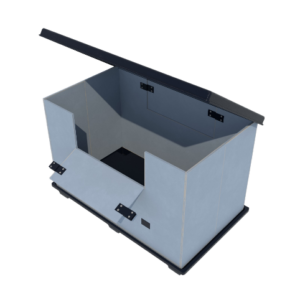
While the AeroPro Box is designed for FLC heavy duty box, lid and pallets, the same thermoformed and injection-molded approach applies across a wide range of industrial material handing or packaging solutions for safer transport of fragile items. The underlying plastic for pallets and boxes can be adapted for contract packaging, battery packaging, furniture packaging, automotive parts and other sensitive-goods applications where durability, stackability, and protection during transit all matter. Businesses evaluating material handling manufacturing partners are increasingly looking beyond single-use a 3 ply bubble honey comb board packaging toward reusable, engineered alternatives that hold up across the full supply chain from the factory floor to the export dock till the end customer.
For companies sourcing from large Aeropro Box (FLC box lid and pallet) suppliers or comparing wooden, metal and plastic pallet manufacturers, the real question isn’t just price per unit. It’s total cost over working life — freight, storage, breakage, replacement frequency, and compliance overhead all factor in, and that’s where engineered AeroPro Box, which is durable and reusable and scratch-proof and prevents water, also consistently outperforms from wood, metal, and carton.
The Sustainability Case
This is where AeroPro Box (FLC Box Lid and pallet) makes its strongest, and that why we consider ourselves a sustainable manufacturer of heavy duty FLC Box lid and pallets. Every wooden crate that gets replaced is one less tree cut down and one less shipment of low-value waste headed to a landfill or a fumigation chamber. Every metal box replaced cuts out the heavy energy footprint of production and the corrosion-driven early replacement cycle. Every single-use paper carton avoided means one less piece of packaging that gets used once and discarded.
Because AeroPro Boxes are engineered for recyclable at end of life and built to survive dozens or even hundreds of trips before that points the actual environmental footprint per shipment drops dramatically compared to a single-use or short-lifespan alternative. Fewer pallets manufactured, fewer pallets discarded, and a real reduction in the raw material and energy pulled into the packaging supply chain over time.
In short: the AeroPro Box isn’t just a stronger, lighter, more cost-effective replacement for wood, metal, and carton . it’s a shift toward solutions that are designed to be used again, not thrown away.
The Takeaway
Traditional packaging materials were never chosen because they were ideal and they were chosen because better alternatives didn’t exist yet at scale. The AeroPro Box changes that equation. Whether the application calls for the lighter, nestable thermoformed variant or the heavy-duty, racking-ready injection-molded variant.
Frequently Asked Questions
What’s the difference between the thermoformed and injection-molded AeroPro Box?
The thermoformed variant is lighter in weight,easier manual handling and lower for freight cost logistics it isbest suited for lighter loads limited-reuse applications upto 40-50 per trips, functioning well as Industrial FLC Box Lid pallets for storage. The injection-moulded variant is a true heavy-duty FLC box pallet, built for heavy loads, racking systems, and long-term reuse.
Can the AeroPro Box actually replace wooden crates for export shipments?
Yes, Both the variants are export-ready and eliminate the common wood-crate issues of fumigation requirements, splintering, and moisture damage, while offering comparable or better load-bearing performance depending on which variant is chosen.
How many times can an AeroPro Box be reused?
The thermoformed variant is rated for roughly 40–50 trips, and the injection-molded variant can handle 100+ trips, far beyond what a paper carton or an average wooden crate can survive.
Is the AeroPro Box suitable for racking systems?
The injection-molded variant is suitable for racking loads, making it one of the more capable industrial plastic pallets for warehouse use. The thermoformed variant is better suited to stacking rather than racking, given its lower dynamic and racking load capacity.
Is the AeroPro Box recyclable?
Yes, Unlike wood (which is often discarded or burned after damage) or single-use carton (which is typically not reused), the AeroPro Box is recyclable at the end of its usable life, in addition to surviving many reuse cycles before it gets there — a core part of why we position ourselves as a sustainable packaging company.
Will switching to AeroPro Box reduce our freight costs?
Yes, Both variants are lighter than wooden crates and metal boxes of comparable strength, which reduces dead weight on outbound shipments. The thermoformed variant’s nesting capability also reduces the freight and storage footprint of empty pallet returns.
Does AeroPro Box come in standard pallet sizes?
Yes, it’s available in the 1200 × 1000 mm and 1200 × 800 mm sizes commonly used across export and warehouse operations, with the injection-molded variant also offered in the 1200 × 1000 mm size for heavy-duty applications.
What plastic pallet material is used to make the AeroPro Box?
The AeroPro Box is manufactured using engineered plastic resins suited to each process — thermoforming for the lighter, nestable variant, and injection molding for the heavy duty pallet variant. Both are chosen specifically for load performance, recyclability, and multi-trip durability.
Can AeroPro Box can be used for products beyond pallets, like batteries or furniture?
Yes, the same engineering principles behind the AeroPro Box extend to broader industrial packaging solutions, including contract packaging, battery packaging, furniture packaging and pharmaceuticals and automotive parts, wherever businesses need a durable, reusable alternative to single-use carton packaging.
Which variant should we choose for our operation?
It depends on load and reuse requirements. If you’re dealing with lighter loads, one-way shipments, or cost-sensitive applications, the thermoformed variant is usually the better fit. If you need racking compatibility, heavy loads, or a long-term reusable fleet, the injection-moulded heavy-duty pallet is the stronger choice.
For more details visit our official website: https://aerolam.com/
Social Media link.
LinkedIn: https://www.linkedin.com/company/aerolam/
Instagram: https://www.instagram.com/aerolamindia/
Facebook: https://www.facebook.com/aerolam
Email id- contactus@aerolam.com