
Data centers do not run on the servers alone. They do run on cooling, and specifically on getting cooled air to exactly the right rack, and the Data centre’s do not run on servers alone. They run on cooling, and specifically on getting cooled air to exactly the right rack, at exactly right temperature, without losing performance along the way. That’s a harder problem than it sounds, and the part of the system that usually gets the least credit for solving it is the ductwork itself, and more precisely, what that ductwork is insulated with.
This is where the Aerolam XLPE HVAC duct insulation comes in. It’s not a glamorous product. But where the facility swings two degrees in a rack temperature can trigger throttling or downtime, insulation quality is doing more load-bearing work than most people realize.
Why Data Centre Cooling Isn’t Like Ordinary HVAC
In a typical office building, HVAC exists for human comfort, and a few degrees of drift barely registers.
A data centre is an entirely different problem from the typical office building. Servers and networking gear throw off enormous, concentrated heat, and the cooling system has to hold tight temperature and humidity bands to keep that hardware from overheating or failing.
Ducts are the delivery mechanism for that cooling. They carry conditioned air from CRAHs, in-row units, or raised-floor systems to the exact point it’s needed, and carry hot exhaust air away just as precisely. If the duct itself is leaking heat, sweating, or losing pressure along the way, none of the sophistication upstream in the cooling plant actually reaches the rack.
That’s the gap Aerolam XLPE HVAC duct insulation is built to close not just by replacing the cooling system, but by making sure the air it produces actually arrives at the right temperature.
The Real Problem: Standard Ductwork Wasn’t Designed for This
Most of the data centres do not have identical layouts but the deeper issue is not about the shape; it’s about insulation performance. When ductwork is not insulated properly, a few predictable failures show up:
- Uneven airflow distribution that creates hotspots at specific racks, even when overall cooling capacity looks adequate on paper
- Heat gain or loss along the duct run, so the air reaching the rack isn’t actually the temperature the cooling unit produced
- Condensation on the duct surfaces where the warm ambient air meets a poorly insulated cold-air duct which is risking the moisture near sensitive electronics.
- Higher energy draw, as cooling units compensate for losses in the delivery path rather than losses at the source
- Mixing between hot-aisle and cold-aisle air where insulation and sealing are weak, undermining the whole containment strategy
Individually, each of these looks like a minor inefficiency. Stacked across a full facility running continuously, they add up to real energy cost and real equipment risk.
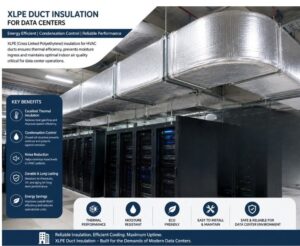
How Aerolam XLPE HVAC Duct Insulation Resolves It
XLPE HVAC Duct cross-linked polyethylene is used here because of how it behaves thermally and physically over long service life. Aerolam’s XLPE HVAC duct insulation addresses the failure points above directly:
Consistent balance of the air temperature run the full duct.
Because the insulation layer resists heat transfer effectively, air leaving the CRAH or in-row unit arrives at the rack close to the temperature it started at, instead of picking up ambient heat along a long duct path.
Condensation control
A well-insulated cold-air duct does not become a cold surface that ambient moisture condenses on.
It directly has raised-floor and overhead duct runs positioned near cabling and the equipment.
Tighter hot aisle / cold aisle separation
The insulation performs consistently across all joints and runs, it supports the airtight separation that cold aisle/hot aisle containment depends on, reducing the recirculation losses that undercut the cooling efficiency.
Lower cooling system strain
When less heat is gained or lost in transit, CRAHs and chillers aren’t compensating for duct losses on top of the actual server heat load. That translates into fans and compressors running closer to their efficient operating range, not constantly working to make up for the ductwork.
Durability suited to long facility lifespans
Data centre infrastructure is expected to run for years without major rework. HVAC XLPE’s Duct Insulation resistance to thermal cycling and general wear supports that expectation, rather than requiring re-insulation partway through a facility’s operating life.
Design Considerations That Still Matter
Insulation material solves one part of the equation, not the whole thing. Getting real the performance out of Aerolam XLPE HVAC duct insulation depends on the broader duct design:
- A proper heat-load assessment of the rack layout, so duct sizing and airflow volume actually match equipment demand.
- Airflow modelling (CFD, where justified) to avoid recirculation between cold and hot aisles.
- Low-leakage joints and seals, since even well-insulated ductwork underperforms if air escapes at the seams.
- Modular or sectional duct components, so the system can easily adapt as racks and cooling loads change without a full rebuild.
What This Means for Energy Use and Sustainability
Cooling is typically one of the largest line items in a data centre’s power draw. Insulation that actually holds its performance over time reduces the amount of cooling capacity spent compensating for losses in the delivery path, rather than the server heat load itself. That has a direct effect on operating cost, and it also supports the kind of energy-efficiency metrics facilities are increasingly expected to report against, including alignment with green building frameworks, where the duct insulation performance is part of the picture.
Maintenance: What to Watch For Over Time
Even well-insulated ductwork needs a maintenance approach that matches how data centers actually operate:
- Periodic inspection for dust, debris, or microbial buildup inside ducts, particularly where filtration is marginal
- Checking for physical damage from vibration, facility modifications, or settling, since a compromised seal undoes the benefit of the insulation around it
- Designing access panels into tight duct runs from the start, rather than discovering later that a section is unreachable without major disruption.
- Where possible, using pressure and temperature sensors along duct runs to catch developing issues before they show up as rack-level temperature problems
What fact should be considered while selecting the insulation of data centres?
- The R-value/U-value should be taken into consideration.
- While fire safety requires materials to comply with fire codes and resist ignition.
- Acoustic Performance is also important, as it serves as soundproofing.
- It helps in lifespan, which helps in reducing the replacement cost and makes it more durable.
- Ease in handling with installation methods and moisture free and reduce the labour cost, which balance the initial investment with long term lifecycle savings.
The Bottom Line
Ductwork rarely gets discussed the way chillers or CRAHs(specialized air-handling units used in data centres to cool and circulate air around IT equipment) do, but it’s the last link between a well-designed cooling system and the actual temperature at the rack. Aerolam XLPE HVAC duct insulation is built to make sure that last link doesn’t quietly undo the work being done upstream and holding air temperature, resisting condensation, supporting aisle containment, and doing it over the kind of multi-year timeline data centre infrastructure is expected to run without rework.
Frequently Asked Questions(FAQ)
What is XLPE, and why is it used for HVAC duct insulation?
XLPE stands for cross-linked polyethylene. It’s used in HVAC duct insulation because of its thermal resistance and durability over long-term, continuous-use environments like data centers, where insulation is expected to keep performing for years without replacement.
How does duct insulation affect data center energy costs?
Poorly insulated ducts lose or gain heat along the airflow path, forcing cooling units to work harder to compensate. Properly insulated ductwork reduces that loss, which lowers the energy draw needed to maintain rack-level temperatures.
Can Aerolam XLPE insulation help prevent condensation in duct systems?
Yes. Insulating cold-air ducts effectively reduces the surface temperature difference that causes ambient moisture to condense on the duct exterior, which matters for equipment and cabling positioned near duct runs.
Does this insulation work with cold aisle/hot aisle containment strategies?
Yes. Consistent insulation performance across duct runs and joints supports the airtight separation that cold aisle/hot aisle containment relies on, reducing recirculation between the two air streams.
Is custom ductwork always necessary, or can standard duct sizes work?
Most data centres have unique rack layouts and heat loads, so standard duct configurations often leave gaps in airflow coverage. Custom-sized and properly insulated ductwork is generally needed to avoid hotspots and uneven cooling.
How often should insulated HVAC ductwork be inspected in a data centre?
There’s no single fixed interval — it depends on filtration quality, facility activity, and duct accessibility — but periodic visual inspection combined with pressure/temperature monitoring where feasible is the standard approach to catching issues early.
For more details, visit our official website: https://aerolam.com/
Social Media link.
LinkedIn: https://www.linkedin.com/company/aerolam/
Instagram: https://www.instagram.com/aerolamindia/
Facebook: https://www.facebook.com/aerolam
Email id- contactus@aerolam.com