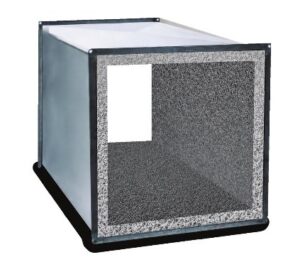
Saves energy, absorbs sound — that’s the one-line pitch. But the more useful question is: on your project, where exactly does it belong? Here’s the application-wise breakdown, with the NRC and STC numbers to back it up.
If you’ve ever stood next to a running AHU, a DG set on load, or a duct system carrying air at speed, you already know the problem AeroAcoustic is built for. It’s not abstract “noise pollution” — it’s a specific, located sound: the whine of a fan, the drone of a compressor, the low rumble that travels through a shared wall into someone’s office.
Aerolam makes two versions of AeroAcoustic, in cross-linked polyethylene foam, aimed at two different jobs — one for lining equipment and ductwork, the other for treating walls and rooms. Below, we’ve matched each to where it actually gets used.
The Two AeroAcoustic Products, in Plain Terms
AeroAcoustic Semi-open Cell
Built for lining the inside of equipment and ductwork — fans, HVAC ducts, compressor housings, pump and engine casings. Comes with one side semi-open cell, reinforced aluminium foil, or self-adhesive facing, so it can go straight onto a duct wall or housing panel.
AeroAcoustic Open Cell
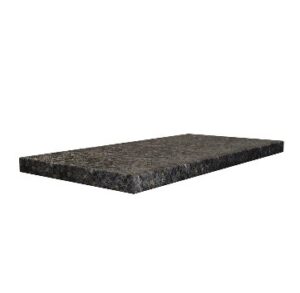
Built to sit inside a wall or partition and stop noise from crossing it — used in AHU rooms, DG rooms, duct liners, and auditoriums. Available Plain, or with a non-woven (NW) facing on one or both sides, which changes its absorption and transmission numbers.
Two numbers worth knowing before you read on: NRC (Noise Reduction Coefficient) tells you how much sound a material absorbs rather than reflects — higher is better for echo and reverberation. STC (Sound Transmission Class) tells you how much sound a barrier blocks from passing through it — higher is better for keeping noise from one room out of the next. You’ll see both used below, because ducts and rooms have different jobs to do.
Application by Application
SEMI-OPEN CELL
Fans and Blowers
A fan’s noise is mostly mechanical — blade pass tones and motor whine — and it radiates straight out through the housing. Lining the inside of the fan casing with AeroAcoustic semi-open cell foam gives that noise something to be absorbed into instead of bouncing straight back out.
STC-31 · NRC-0.25 (semi-open cell, as tested)
SEMI-OPEN CELL
HVAC Duct Lining
Air handling ducts carry sound as efficiently as they carry air — a noisy AHU a floor away can announce itself through the ductwork long before you feel the airflow. Lining the duct interior is one of the few treatments that attacks noise exactly where it travels, without adding external bulk.
Working range −20°C to 110°C · Class O fire rating (BS 476 Parts 6 & 7)
SEMI-OPEN CELL
Compressor Housings
Compressors run continuously and generate a steady, high-frequency drone that’s exhausting to be around for a full shift. A foil-faced or self-adhesive AeroAcoustic lining inside the housing panel cuts that drone at the source, rather than relying on distance or enclosure walls alone.
Antifungal (ASTM G21) & antimicrobial (ISO 22196) — a real consideration in enclosed, often humid housings
SEMI-OPEN CELL
Pump and Engine Casings
Similar story to compressors: vibration-driven noise inside a sealed casing needs somewhere to go. The self-adhesive facing option is particularly useful here, since it lets the foam be applied directly to irregular casing surfaces without extra fixings.
Water absorption 0.00056 mg/m² (JIS K6767) — stays effective even in wet plant rooms
OPEN CELL
AHU Rooms
An AHU room is a box built around a machine that vibrates and hums all day, and every wall of that box is a potential noise leak into the rest of the building. Lining those walls with AeroAcoustic open cell foam — ideally the both-side NW facing — pushes the Sound Transmission Class up to 22, meaningfully cutting what escapes into adjoining spaces.
Both-side NW: STC-22 · NRC-0.70 (IS 140 / IS 9901-III / ASTM E90-413, IS 8225 / ISO 354 / ASTM C423)
OPEN CELL
DG (Diesel Generator) Rooms
DG rooms are, frankly, one of the harder noise problems in a building — an engine under load, run intermittently, often right next to occupied areas. Open cell AeroAcoustic panels on the room’s internal walls give the space genuine sound-absorbing mass rather than just a thin acoustic veneer.
Air erosion tested to 10,000 fpm (ASTM C1071-19) — built for continuous high-airflow environments
OPEN CELL
Duct Liners (Room-Side Treatment)
Where semi-open cell foam lines the inside of the duct itself, open cell AeroAcoustic is used more broadly as a duct-liner-style treatment on plant room walls and risers — softening the reflected noise that builds up in mechanical spaces packed with ductwork.
Thickness range 15–100 mm · panel size 900 mm × 900 mm
OPEN CELL
Auditoriums and Large Halls
Here the goal flips slightly — it’s less about blocking noise from a machine and more about controlling how sound behaves inside the room itself. The one-side NW variant’s NRC of 0.80 makes it well suited to absorbing reflections and taming echo in a hall where speech clarity actually matters.
One-side NW: NRC-0.80 — the highest absorption figure across the AeroAcoustic open cell range
Choosing Between the Two: A Quick Way to Decide
- Treating the inside of a machine or duct? That’s semi-open cell — pick the facing (semi-open cell face, foil, or self-adhesive) based on how it needs to be fixed.
- Treating a wall, partition, or room? That’s open cell — Plain if budget-led, one-side NW if you need maximum absorption (auditoriums), both-side NW if you need maximum transmission blocking (AHU/DG rooms shared with occupied space).
- Not sure which matters more, NRC or STC, for your space? If people complain about echo inside the room, you need absorption (NRC). If people outside the room complain about noise from inside it, you need transmission loss (STC).
Frequently Asked Questions
Q1 What’s the difference between AeroAcoustic semi-open cell and open cell?
Semi-open cell is designed to line equipment and ductwork directly — fans, HVAC ducts, compressor housings, pump and engine casings. Open cell is designed to go into walls and partitions to reduce noise transfer between rooms — AHU rooms, DG rooms, duct liners, and auditoriums.
Q2 Which facing gives the best noise blocking for an AHU or DG room?
Both-side NW open cell gives the highest Sound Transmission Class in the range, at STC-22, making it the strongest option where the priority is keeping machine noise from crossing into occupied space.
Q3 Is AeroAcoustic safe to use in continuously humid or enclosed plant spaces?
Yes. The semi-open cell version is rated antifungal (ASTM G21) and antimicrobial (ISO 22196) with near-zero water absorption, and the open cell version shows no fungal growth under ASTM G21 as well.
Q4 What thickness and panel size does AeroAcoustic open cell come in?
Open cell panels are available from 15 mm up to 100 mm thick, in a standard 900 mm x 900 mm size.
For more details visit our official website: https://aerolam.com/
Social Media link.
LinkedIn: https://www.linkedin.com/company/aerolam/
Instagram: https://www.instagram.com/aerolamindia/
Facebook: https://www.facebook.com/aerolam
Email id- contactus@aerolam.com