
When specifying insulation for HVAC systems, compressor rooms, or mechanical enclosures, acoustic performance is usually the starting point. The material you choose also determines how a space performs on fire safety, how it holds up against moisture over years of service, and whether it meets indoor air quality requirements that are becoming standard on commercial and institutional projects.
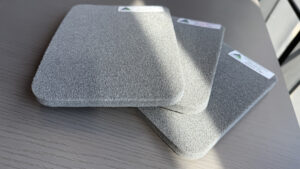
Aero Acoustic Semi-Open Cell XLPE addresses all of this. It is a cross-linked polyethene foam that delivers certified NRC and STC ratings and goes significantly further.
What Makes It Different
Most acoustic foams are built around one goal. Open-cell polyethylene absorbs sound well but presents a serious fire risk. Fibrous materials pass fire codes but retain moisture and support mould growth over time. Aero Acoustic Semi-Open Cell is built on an XLPE base, which means the fire safety, moisture resistance, and hygiene credentials come from the material itself, not from coatings or treatments that degrade.
The semi-open cell structure is what drives the acoustic performance. Unlike standard closed-cell XLPE, the interconnected pores allow sound energy to enter the material and dissipate, rather than reflect. This is genuine absorption, the same mechanism behind high-performance acoustic treatment achieved within a material that also carries a Class O fire rating and zero moisture absorption.
Key Specifications
Acoustic
- NRC: 0.25 – as per ISO 354 / ASTM C423 / IS 8225
- STC: 31 – as per ASTM E490/413
Thermal
- Thermal Conductivity: 0.0329 W/m·K at 23°C – as per ASTM C518
Physical
- Density: 30 kg/m³ (±5)
- Water Vapour Permeability: Almost 0.00 – as per ASTM E96
- Water Absorption: 0.00056 mg/m² – as per JIS K6767
Fire and Safety
- Fire Resistance: Class O – as per BS 476 Part 6 & Part 7
- CFC / HCFC Free: Pass – as per USEPA 8260 B
Health
- VOC Level: 0.018 mg/m/hr – as per ASTM D5116
- Antifungal: Yes – as per ASTM G21
- Antimicrobial: Yes – as per ISO 22196
Facing Options: One side semi-open cell / Self-adhesive / Aluminium foil with reinforcement
Fire Safety You Can Rely On
Acoustic insulation is installed inside ducts, within wall cavities, and around mechanical equipment spaces that are hard to access and rarely inspected. What a material does under fire conditions matters more in these locations than almost anywhere else.
Aero Acoustic Semi-Open Cell carries a Class O rating under BS 476 Parts 6 and 7, the highest classification for both fire propagation and surface spread of flame under British Standards. It is self-extinguishing, produces low smoke density, and generates no halogenated gases. For project teams working to fire compliance requirements, this rating simplifies specification and reduces the need for additional fire barriers in many assemblies.
Moisture and Microbial Resistance
Acoustic insulation in HVAC and mechanical applications is almost always installed in environments where condensation occurs. This is where fibrous and porous materials tend to fail over time. They absorb moisture, and once they do, they support the conditions for fungal and bacterial growth.
XLPE’s cellular structure does not absorb moisture. The material carries independently certified antifungal performance (ASTM G21) and antimicrobial performance (ISO 22196), and because these properties are intrinsic to the polymer, not applied as a surface treatment, they remain consistent across the product’s service life. Combined with low VOC emissions of 0.018 mg/m/hr, it supports indoor air quality compliance on projects requiring green building certification.
Where It Works
Aero Acoustic Semi-Open Cell is used across commercial, industrial, and institutional projects:
- HVAC duct lining – absorbs fan noise and air turbulence before it exits into occupied spaces
- External duct wrap – controls mechanical breakout noise while providing thermal insulation, contributing to system energy efficiency
- Compressor housing – damps metal panel vibration and reduces equipment noise within enclosures
- Pump and engine casing – limits structure-borne vibration transmission into the building fabric
- High sound-generating mechanical spaces – any environment where acoustic control, fire compliance, and moisture resistance must be delivered together
Easy to Specify, Easier to Install
The product is lightweight, flexible, and cuts cleanly with standard tools. Self-adhesive backing reduces installation time on ductwork. The aluminium foil with reinforcement option provides a durable, finished surface for exposed applications. Because it is fibre-free, no respiratory precautions are required during handling or installation.
Its dimensional stability under temperature cycling and sustained load means it holds its specified performance across a service life measured in years, not seasons.
Acoustic performance in a building depends as much on the longevity and safety of the materials used as it does on their initial NRC rating. Aero Acoustic Semi-Open Cell XLPE is built to deliver on both.