
Airports, metro stations and large transport terminals are among the most complex buildings to design from an HVAC perspective. These facilities must maintain consistent airflow, temperature control, and indoor air quality across massive spaces with constantly changing occupancy levels.
The HVAC ducting system plays a crucial role in achieving the balance. In large infrastructure environments, HVAC duct design must support high air volumes, long distribution networks, and strict performance requirements. This is why many project developers rely on experienced duct manufacturers in India who can design and produce duct systems suited for high-capacity installations.
The scale of HVAC requirements in airports and large terminals.
Airports operating in mini cities are under one single roof. Passenger terminals, baggage handling zones, retail areas, security checkpoints, and boarding gates all require controlled indoor environments.
Aerolam XLPE HVAC systems helps to distribute air efficiently across various:
- Large terminal halls
- Departure and arrival lounges
- Retail and food service zones in airports terminals.
- Operational back-of-house areas
- Security and immigration sections
- Because of the scale of these facilities, ducting systems must move large volumes of air while maintaining pressure balance and consistent airflow throughout the building.
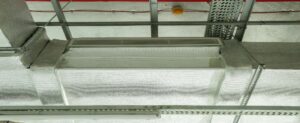
High airflow capacity and longer distribution networks
Unlike the standard commercial buildings and airport HVAC systems often extend across thousands of square meters. Air handling units (AHUs) and ventilation systems must equally supply air across long distances without significant pressure loss.
To support this, duct systems must be designed with:
- Proper sizing for high airflow capacity
- Reinforced duct construction for large cross-sections
- Smooth internal surfaces to minimize air resistance
- Strategically placed dampers for airflow balancing
- Working with experienced duct manufacturers in India ensures that duct fabrication meets the engineering requirements of these large-scale installations.
- Structural strength for large duct sections
Airport projects frequently require oversized duct sections capable of carrying very high air volumes. These ducts must maintain structural integrity even when exposed to air pressure, vibration, and operational loads.
Manufacturing considerations for these ducts include:
- Reinforced panel construction
- Proper stiffening techniques
- High-quality sheet metal fabrication
- Secure flange and joint systems
- These structural elements help to ensure the long-term reliability for demanding infrastructure environments.
Integration with complex mechanical systems
Large infrastructure buildings can contain numerous mechanical systems and various operating system. HVAC ducting must integrate seamlessly with equipment such as:
- Air Handling Units (AHUs)
- Smoke extraction systems
- Pressurization systems
- Energy recovery units
- Chilled water-cooling systems
- Proper duct design to ensures the airflow is distributed equally and efficiently while supporting the overall building mechanical strategy
Fire safety and smoke control requirements
Airports and major transport facilities must comply with strict fire safety standards. HVAC duct systems are often integrated with smoke management systems designed to control airflow during emergencies.
The systems includes:
- Smoke extraction ducts
- Fire-rated duct sections
- Fire and smoke dampers
- Pressurization ducts for escape routes
- Reliable duct construction is critical in ensuring these systems operate effectively when it is required.
- Durability for a continuous operations.
Unlike many other commercial buildings, airports operate around the clock. HVAC systems must function continuously to maintain passenger comfort and protect sensitive equipment’s in the airports.
Duct systems used in these environments must be manufactured using materials and fabrication methods that supports the long-term durability of HVAC Duct and a High-quality duct fabrication ensures that the system performs efficiently even under constant operational loads.
Supporting large infrastructure development in the India.
India continues to invest heavily in aviation, logistics, and transport infrastructure. Projects such as airport expansions, new terminals, and large exhibition centers require advanced HVAC systems capable of supporting large building volumes.
Reliable HAVC duct fabrication plays a crucial key role in the success of these projects. Partnering with experienced duct manufacturers in India helps ensure that HVAC ducting systems meet the structural, performance, and regulatory requirements of large infrastructure developments.
(FAQ) Frequently Asked Questions
- 1. Can XLPE Foam be wrapped around ducts? Yes, XLPE can be wrapped around ducts. But insulations wrapped around ducts may leave air pockets which can cause condensation in future.
- 2.Why is HVAC duct design more complex for airports than for typical commercial buildings? Airports combines multiple zones with very different air quality, temperature, and occupancy demands on terminal halls, retail areas, security checkpoints, and back-of-house zones and all under one roof, and all operating one a continuous basis. The duct network has to move much higher and larger air volumes over longer distances while keeping the pressure balanced across all over the entire building, which is a fundamentally bigger engineering problem than ducting a single office floor or retail unit.
- 3.What does “pressure balance” mean in the context of airport ducting, and why does it matter? Pressure balance refers to keeping the airflow consistent across every zone of the building of the airports, so no single area is starved of air while another is over-pressurized to release the air. In an airport, an imbalance can means the poor air quality in a crowded departure lounge, uncomfortable drafts near boarding gates, or smoke management systems failing to perform as designed. Getting this right requires correct duct sizing, damper placement, and network layout from the start to get the proper duct solutions.
- 4.How is smoke management integrated into the HVAC duct network, and is it a separate system? Smoke management is usually built into the same overall duct network rather than run as a fully independent system, though it uses dedicated components are smoke extraction ducts, fire-rated sections, and fire/smoke dampers that only activate the specific function during an emergency. Pressurization ducts for escape routes work alongside these to keep evacuation paths clear of smoke. Because this equipment has to work correctly on the rare occasion it’s actually needed, the fabrication quality and damper reliability matter more here than almost anywhere else in the system.
- 5.What makes duct sections structurally different for large infrastructure projects like airports versus a standard commercial building? Airport ducting needs oversized cross-sections to carry a very high air volumes. which means the panels need reinforcement, proper stiffening, and secure flange and joint systems to resist air pressure and vibration over years of continuous usage. A standard commercial building’s ducting rarely faces the same combination of scale and 24/7 operational load, so the fabrication standards and material specifications for airport-grade ducts are typically higher across the airports.
- 6.Why does 24/7 operation change how ducting should be manufactured and specified? Most of the commercial HVAC systems get some downtime overnight or on weekends. which gives components a chance to rest and reduces cumulative wear. Airports run continuously, so ducts, dampers, and joints are under constant thermal and mechanical stress with far fewer maintenance windows. The specification pushes more towards Aerolam XLPE HVAC Insulation for more durable materials and easy fabrication methods that are built to perform reliably without shutdowns for repair.
- 7.How does duct design need to account for mechanical systems like AHUs, energy recovery units, and chilled water systems? Ducting do not operate in isolation. it’s is the distribution layer connecting the air handling units and energy recovery units, pressurization systems, and chilled water-cooling systems into one coordinated airflow strategy.If the duct sizing, routing, or damper placement doesn’t align with how these systems are meant to interact the building’s overall mechanical strategy can underperform.Even if each individual piece of equipment is correctly specified. This is why duct design is usually finalized in coordination with the broader mechanical engineering plan.
- 8.Why do large infrastructure projects specifically look for experienced duct manufacturers rather than any general fabricator? Airport-scale projects combine high air volumes distribution and long distribution runs, strict fire and smoke regulations, and continuous operational demands.Experienced manufacturers bring the tested approaches to reinforcement, sizing, and joint construction that hold up under these complex specific conditions, which reduces the risk of performance issues, compliance failures, or premature maintenance needs after the project is handed over.
- 9.Is this kind of HVAC ducting relevant only to airports, or does it apply to other large infrastructure too? The same underlying requirements: high airflow capacity, structural strength, fire and smoke integration, and 24/7 durability apply to metro stations, large transport terminals, exhibition centers, and similar high-occupancy infrastructure. Airports are simply one of the most demanding examples, which makes them a useful reference point, but the design principles carry over to any large-scale, continuously operating public building.10.What role does India’s ongoing infrastructure growth play in demand for this type of duct system? As India continues to expand its aviation, logistics, and transport infrastructure through airport expansions, new terminals, and large exhibition venues. The number of projects requiring high-capacity, code-compliant HVAC ducting is growing accordingly. This is increasing demand for manufacturers who can reliably deliver duct systems engineered specifically for large-scale, high-occupancy environments rather than standard commercial-grade specifications.
For more details visit our official website: https://aerolam.com/
Social Media link.
LinkedIn: https://www.linkedin.com/company/aerolam/
Instagram: https://www.instagram.com/aerolamindia/
Facebook: https://www.facebook.com/aerolam
Email id- contactus@aerolam.com