
Everyone insulates the ducts. Everyone insulates the pipes. But then the chiller plant room gets a coat of whatever is left in the budget or nothing at all.
Here is the thing that the plant room is where the ‘cold’ is actually made. The chiller, the AHU, and the suction lines run at cooler temperatures than those of its surroundings. This comes up to a significant difference, sustained all day. Every bit of heat that creeps in through an uninsulated surface is additional heat for the compressor to fight. The compressor is the most power-hungry part of the entire system.
So why does plant room insulation still get overlooked? Partly because the damage is not visible. The ducts are hidden in the ceiling. While the plant room is tucked away. But the energy losses are very much real.
The Moisture Problem Nobody Talks About
Heat gain is the obvious issue. Moisture is the one that quietly kills the insulation.
Low-temperature surfaces condense the most for moisture from the air. Once moisture gets into an open-cell insulation material. it does not leave the wet insulation conducts heat significantly faster than dry insulation, so whatever thermal resistance you specified at commissioning, you are getting less of it every year.
Pipe insulation is where this plays out most visible. On a chilled water line any break in the vapour barrier, a poorly sealed joint, a fitting left uninsulated, or a gap at a flange, becomes a condensation point.
From there if moisture wicks into adjacent insulation and the degradation spreads outward. By the time it’s noticeable, the damage is already done across a significant length of pipework.
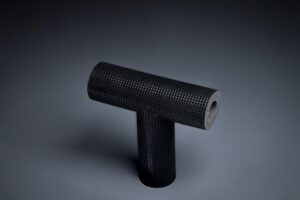
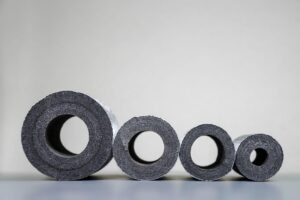
The chiller line is the most critical one to get right. It carries low-pressure refrigerant back to the compressor at some of the lowest temperatures in the system. Heat gain on that line raises the suction temperature, which directly reduces compressor efficiency and increases power draw. The large-diameter chilled water header pipes in the plant room, which feed the entire building’s cooling circuits, have the same exposure to this constant heat. Thermal gain here affects every zone, not just one.
This is why the material choice matters more in plant rooms than almost anywhere else. Aerolam XLPE is a chemically cross-linked, closed-cell polyethene foam. The closed-cell structure means there are literally no pathways for moisture to travel through. The insulation that goes in on day one performs the same way ten years later. That’s the whole point.
One of the unique characteristics of Aerolam’s XLPE is its stable K value, which measures thermal conductivity.
Unlike the other insulation materials whose thermal performance decreases with moisture absorption or temperature cycling, Aerolam XLPE Duct maintains consistent thermal resistance throughout its service life.
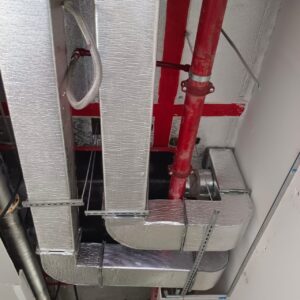
Fire Safety – Essential Since Plant Rooms Are Enclosed Spaces
This aspect often gets neglected. A plant room is typically a windowless, mechanically ventilated space with one or two entry points. The fire performance of everything installed in there matters not just structurally, but for the people working in it.
Aerolam XLPE’s fire and smoke specifications:
- Class O – BS 476 Part 6 and Part 7
- ASTM E84 (NFPA 90A and B) – Flame Spread Index <25, Smoke Development Index <50
- FM 4924 approval – COC Identification: 3063893
- EN 45545 – R1HL3 (European railway standard for fire and smoke)
- EN 13501 – B-s1 d0
- UL 94 HF-1 – File No: E504824
Aerolam’s XLPE also holds GreenPro certification, which gives assurance of Green building energy and with other certifications like EPD (International EPD System) and European Standards.
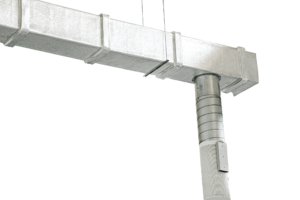
Technical Specifications
| Feature | Range / Details |
| Thickness | 6 mm to 50 mm |
| Inner Diameter (ID) | Up to 1200 mm |
| Standard Lengths | 1.2 m, 1.5 m, 2 m |
| Cladding Options | Alupet, Aeroclad, Glass Cloth, UV-resistant, and Plain |
Table 1
| Thickness | Width | Length | Total SQM |
| 3mm | 1.2m | 100m | 120 |
| 3mm | 1.2m | – | – |
| 3mm | 1.2m | 80m | 96 |
| 3mm | 1.2m | 70m | 84 |
| 3mm | 1.2m | 50m | 60 |
| 3mm | 1.2m | 45m | 54 |
| 3mm | 1.2m | 30m | 36 |
| 3mm | 1.2m | 30m | 36 |
Table 2
| Thickness | Width | Length | Total SQM |
| 15mm | 1.2m | 25m | 30 |
| 19mm | 1.2m | 20m | 24 |
| 25mm | 1.2m | 16m | 19.2 |
| 30mm | 1.2m | – | – |
| 32mm | 1.2m | – | – |
| 40mm | 1.2m | – | – |
| 45mm | 1.2m | – | – |
| 50mm | 1.2m | 2m | 2.4 |
Installation is straightforward. The material is flexible, cuts easily around fittings and flanges, and bonds with standard contact adhesive. It’s also dust-free and fibre-free, which matters for healthcare and pharma sites where air quality standards apply to mechanical rooms as well.