
For decades, industrial packaging has followed a simple, largely unquestioned logic: shipping of goods and dispose of the packaging. Cardboard boxes and wooden crates have been the default across almost every supply chain in India, not because they are the best option, but because they appeared to be cheapest on paper.
The calculation is no longer holding up. Freight costs have increased. Regulations are placing legal obligations on businesses to account for packaging waste. Global buyers are auditing Indian suppliers for recyclability before signing the contracts.
And internally, procurement teams are being asked to demonstrate how costs can be reduced without compromising product protection. Transit damage claims alone cost India’s logistics sector upwards of Rs. 15,000 crore annually, most of it traced back to moisture ingress, surface abrasion, and structural failure under stacking loads. They are what happens when packaging is not built to go the distance.
Returnable packaging built to survive the journey, come back, and go again addresses all of this at once. this costs less per trip over and its service life, generates less waste to meets requirements and delivers the better product protection than single-use formats. The shift is already underway across the automotive, electronics, food processing, and pharmaceutical sectors.
What Returnable Packaging Actually Requires
A returnable system only works if the return economics work. For that, a few things have to be true:
- The packaging must collapse significantly when empty; otherwise, return freight costs cancel out the savings.
- Assembly must be fast and tool-free, or warehouse teams simply won’t use it consistently.
- The material must not degrade across trips. Polypropylene holds its structural performance from the first use to the last, where cardboard doesn’t.
- It must fit standard forklifts, racking, and container configurations without creating new handling problems.
How Collapsible Design Changes Logistics Economics
- This is the part procurement teams find most compelling once they actually work through the numbers. Traditional rigid pallet boxes work well on the outbound trip but become a serious logistics burden on the return leg.
- Empty rigid boxes occupy the same truck volume as loaded ones, which means you essentially pay for full freight to ship empty packaging back to the origin.
- For high-frequency returnable programmers, this reverse-logistics cost can eat up most of the savings the returnable packaging was supposed to deliver.
- AeroPro Box pallet lid and sleeve systems collapse and reduce return freight volume by up to 70 percent. Storage space at warehouses drops by up to 80 percent when empty units are nested and stored flat. Suddenly the returnable programmed becomes genuinely economical, because the return trip costs a fraction of the outbound trip.
- This helps us in reducing the CO2 emissions.
- The operational gain that turns a packaging change into a measurable bottom-line improvement, and it is exactly why a Aerolam’s Aeropro Box has become a serious supply-chain partner for major industrial buyers.
The AeroPro Box
Aerolam’s Aeropro Box is a collapsible box enclosure and edge sealing made from 3-ply PP BubbleGuard Board, a triple-layer polypropylene honeycomb structure produced using patented European co-extrusion technology.
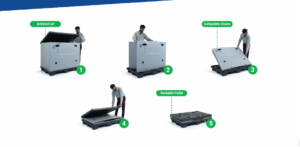
It comprises an anti-skid lid for stable stacking, a collapsible sleeve, and a rackable injection-moulded pallet with a 3-runner base compatible with standard forklifts.
Positioning locks allow full assembly and breakdown without tools or manual fasteners. Optional features include an access window and removable partitions for cargo separation.’
The sleeve collapses flat, reducing return transport volume by 80%. The PP construction is permanently waterproof, dust-proof, and shock resistant. The absence of wood or mixed materials makes it fumigation free, removing the ISPM 15 compliance requirement that applies to wooden packaging on all export shipments.
Specifications
- Material: 3-ply PP BubbleGuard Board, 100% virgin polypropylene, fully recyclable
- GSM Range: 2500- 6500 GSM
- Panel Thickness: 10 mm- 17 mm
- Standard Sizes: 1200 x 800 x 900 mm and 1200 x 1000 x 1100 mm
- Custom Sleeve Height: 610 mm to 1610 mm
- Colours: White, Blue, Grey, Black, Customisable as per need
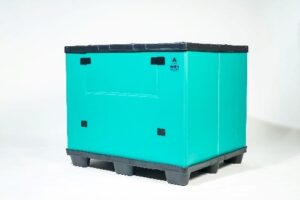
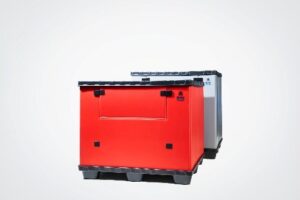
The Aeropro Box comes with two types of technology one comes with injection molded and thermoformed.
Injection-molded lids and pallets are significantly stronger than thermoformed lids and pallets.
- Injection-molded lids and pallets:
- 500 kg – G+2 stacking
- 1,000 kg – G+1 stacking
- Thermoformed lids and pallets:
- 350 kg – G+2 stacking
- 500 kg – G+1 stacking
| Parameter | Thermoformed | Injection Molded |
| Static Load | Low to Medium | High |
| Dynamic Load | Limited | Very High |
| Racking Load | Not Recommended | Suitable |
| Impact Resistance | Medium | High |
| Long-Term Durability | Moderate | Excellent |
Thermoformed lids and pallets provide more internal space compared to injection-molded lids and pallets of the same outer dimensions.
Conclusion
Single-use packaging made sense when freight was cheaper, and sustainability was not a procurement criterion. Neither is true today. The Aeropro Box is built for the logistics environment as it actually exists and delivers measurable returns from the first trip.