
Marine fenders is one of the most important safety systems in ports, harbors, shipyards, and offshore facilities. The primary purpose is to absorb the impact energy generated when a vessel berths is protecting both the ship and the dock from the structural damage.
The materials used in modern fender systems, Cross-Linked Polyethylene (XLPE) foam has become a preferred choice because of its excellent energy absorption, durability, and resistance to harsh marine environments.
Note: This article refers to XLPE foam used in marine fenders, not XLPE electrical cable insulation. Although both are based on cross-linked polyethylene, they are designed for entirely different applications.
What is XLPE Insulation?
XLPE Insulation(Cross-Linked Polyethylene) is a closed-cell polyethylene foam that undergoes a cross-linking process to improve its mechanical strength, flexibility, and water resistance, chemical resistance.
The cross-linked molecular structure provides:
- High impact resistance
- Excellent energy absorption
- Superior buoyancy
- Water resistance ( Almost zero water absorption )
- UV and weather resistance
- Long service life
These properties make XLPE Insulation ideal for manufacturing marine foam-filled fenders.
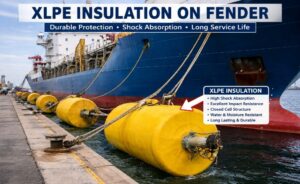
Why Marine Fenders are Important
Every time a ship docks, a large amount of kinetic energy is generated. Without a proper fender system, this energy can cause:
- Damage to the vessel hull
- Cracks in concrete quay walls
- Damage to jetties and dolphins
- Costly repairs
- Operational downtime
- Increased safety risks
Marine fenders act as shock absorbers that safely dissipate this energy.
How XLPE Foam Works in the Marine Fender Systems
A XLPE Insulation filled in a marine fender typically consists of:
- XLPE Insulation Closed-Cell Foam Core: Absorbs and distributes impact the energy.
- Reinforced XLPE polyethylene Closed-Cell : Protects against abrasion, punctures, and marine conditions.
- Steel End Fittings: Secure the fender to docks or floating structures.
When a vessel contacts the fender, the foam compresses and absorbs the impact. After the ship moves away, the foam returns to its original shape without permanent deformation.
Key Benefits of XLPE Foam Marine Fenders
- Excellent Energy Absorption
XLPE Insulation compresses during the impact and reducing it while berthing forces and protecting both the ship and port infrastructure.
- Unsinkable Design
The closed-cell XLPE Insulation prevents water absorption, allowing the fender to remain buoyant even if the outer skin is damaged.
- High Durability
XLPE foam is resistant to:
- Saltwater
- UV radiation
- Marine micro-organisms
- Oils and chemicals
- Weathering
This makes it ideal for long-term outdoor marine applications.
- Low Maintenance
Unlike pneumatic fenders, XLPE Insulation filled fenders:
- Never require air pressure monitoring
- Cannot deflate
- Require minimal maintenance
- Have a long operational life
- Reliable Performance
XLPE Insulation cross linked maintains consistent performance across a wide range of temperatures and environmental conditions.
- Hull Protection
The resilient foam reduces the pressure on the vessel hull and minimizing the risk of dents, scratches, and structural damage during berthing in ports/shipyard.
- Energy absorption: XLPE foam has a closed-cell structure that compresses under impact, absorbing the kinetic energy when a ship contacts the dock.
- Buoyancy: The xlpe closed-cell foam does not absorb water, so it remains buoyant and is suitable for floating fenders – In case of Aerolam XLPE Water Vapour Resistance Factor ( μ ) mu value is 97900 as per Standard EN 12086.
- Impact protection: It reduces the contact forces between the ship and the quay, helping it to prevent damage to both.
- Durability: XLPE foam is resistant to water, many chemicals, UV exposure, and weathering, making it suitable for marine environments.
- Low maintenance: Unlike pneumatic fenders, foam-filled fenders require minimal maintenance and cannot deflate.
Applications of XLPE Foam Marine Fenders
XLPE foam-filled fenders are commonly used in:
- Commercial ports
- Container terminals
- Oil and LNG terminals
- Naval bases
- Shipyards
- Passenger ferry terminals
- Offshore platforms
- Floating docks
- Marinas
- Cruise terminals
Advantages Over Traditional Pneumatic Fenders
| Feature | XLPE Foam Fender | Pneumatic Fender |
| Risk of Deflation | No | Yes |
| Water Absorption | None | None |
| Maintenance | Low | Moderate |
| Impact Resistance | Excellent | Excellent |
| Puncture Risk | Very Low | Higher |
| Buoyancy | Permanent | Depends on air pressure |
| Service Life | Long | Long with regular maintenance |
Environmental Benefits
Modern XLPE foam fenders also supports to the sustainability by:
- Providing a long service life, reducing replacement frequency.
- Requires a less maintenance, lowering resource use.
- Being recyclable in applications, depending on the product design and local recycling capabilities.
- Helping it to prevent from damage to marine infrastructure, reducing repair-related environmental impacts.
- Aerolam XLPE is Green building (GreenPro Certified) compliant as per the different Green building council of different countries.
Choosing the Right XLPE Marine Fender
When selecting a marine fender, consider:
- Vessel size and displacement
- Berthing energy
- Tidal range
- Dock structure
- Environmental conditions
- Fender dimensions
- Energy absorption capacity
- Reaction force
- Compliance with relevant marine standards
A properly engineered fender system ensures a safe and efficient berthing while extending the life of both vessels and port infrastructure from the damage which save the frequent repair.
Frequently Asked Questions (FAQs)
- What is XLPE Insulation?
It is a chemically cross linked closed cell polyolefin foam insulation specially designed for the HVAC segment, under deck insulation and pipe insulation.
- Is XLPE electrical cable insulation the same as XLPE Insulation used in marine fenders?
No, Both use cross-linked polyethylene, but cable insulation is designed for electrical protection, whereas XLPE Insulation is engineered for impact absorption and buoyancy and in some cases Thermal protection.
- Why is XLPE Insulation suitable for marine fenders?
It absorbs impact energy efficiently, resists water absorption, maintains buoyancy, and performs well in harsh marine environments.
- Can XLPE foam marine fenders sink?
No, The closed-cell foam structure provides inherent buoyancy. Even if the outer skin is damaged, the foam core generally continues to float.
- What industries use XLPE marine fenders?
Ports, harbors, shipyards, offshore oil and gas facilities, naval bases, marinas, ferry terminals, and floating dock operators.
- How long do XLPE Insulation marine fenders last?
With the proper design, installation and maintenance, they can provide reliable service for many years. Actual lifespan depends on operating conditions and usage intensity.
- Are XLPE Insulation fenders maintenance-free?
No fender is completely maintenance-free, but XLPE Insulation-filled fenders require significantly less maintenance than pneumatic fenders because they cannot lose air pressure.
- Are XLPE Insulation fenders resistant to seawater?
Yes, XLPE Insulation has excellent resistance to seawater, moisture, UV exposure, and many chemicals encountered in marine environments.
- Can XLPE Insulation withstand heavy ship impacts?
Yes, When engineered for the intended vessel size and berthing energy, XLPE foam fenders are designed to absorb substantial impact forces while limiting reaction forces on the ship and berth.
- What are the main advantages of XLPE Insulation for marine fenders?
The key advantages include high energy absorption, permanent buoyancy, low maintenance, excellent durability, UV and chemical resistance, long service life and reliable performance in demanding marine conditions.
Conclusion
XLPE Insulation has transformed modern marine fender technology by offering a durable, buoyant and highly effective solution for protecting ships and port infrastructure during berthing operations. Compared with traditional alternatives, foam-filled fenders built with XLPE cores deliver dependable performance, lower maintenance requirements, and a long operational lifespan making them an excellent choice for commercial ports, offshore facilities, and maritime industries worldwide.
For more details visit our official website: https://aerolam.com/
Social Media link.
LinkedIn: https://www.linkedin.com/company/aerolam/
Instagram: https://www.instagram.com/aerolamindia/
Facebook: https://www.facebook.com/aerolam
Email id- contactus@aerolam.com